Questions?
Turing’s Contributions
Pre-War
The Turing machine and computability.
The Entscheidungsproblem (aka Decision Problem). Is there a procedure for deciding whether any given mathematical statement can be proven?
Problem: what is the mathematical definition of “procedure”?
Turing: anything doable by an abstract mechanical calculator modeled to some extent on how people carry out “procedures.” This abstract mechanical calculator is the Turing machine.
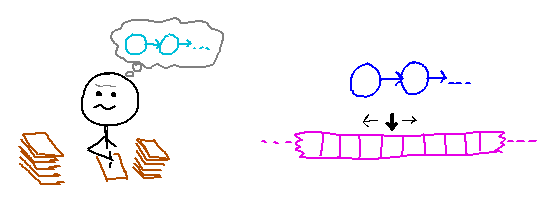
A physical example:
Turing was able to show that no Turing machine can decide whether a mathematical statement is provable, and thus that the answer to the Entscheidungsproblem is “no.” This was one of several unexpected results in the 1930s that showed that there are significant limits to what mathematics as a whole can do.
War-Time
Bombes, but also other mathematical methods of cryptanalysis, speech encipherment, etc.
Post-War
Physical computers: dead-end ACE project, then Manchester.
Can machines think: the Turing test.

Try it
Get into teams of 2 - 4 people.
Pair up with another team that can’t easily see or hear you.
Carry out a conversation with that other team by typing remarks/questions/etc and responses in a section of this Google doc.
Each team decide privately whether to carry out your end of the conversation by responding yourselves (i.e., humans) or by copying remarks to one of the following chatbots and pasting responses into the Google doc (i.e., machine). Decide which you’ll do once and stick to it throughout the conversation.
Try to decide which the other team is doing.
Chatbots
Next
Handling objections to your argument.
Read They Say, I Say chapter 6.