- Fall 2026
- Karate (Experimental)
- (H&PE 188)
- Mondays 12:30-1:45; Schrader 152
| Printable Syllabus | Office Hours Info | Fist Options? |
| Interest Survey | Office Hours | Some info on stances |
| Office Hours Schedule |
- What am I doing here? As with all Phys-Ed courses, the purpose of this class is to “encourage students to find meaningful activities that will lead to life-long leisure pursuits”. This course requires no previous experience with martial arts. You will not engage in combat with others in this class.
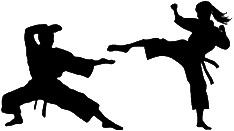
- Over the past one hundred years, many separate forms of karate have evolved, starting mainly in Okinawa (now a part of Japan), and spreading out through Japan, Korea, and the United States. Each style has similarities and differences to the others. Some examples include Shotokan, Kyokushin, Goju-Ryu, Isshin-Ryu, and even Tang Soo Do (which is more Korean than Japanese). Our class will not follow any specific style exactly, but will incorporate elements from each of them. Although most karate classes are conducted using Japanese or Korean vocabulary, we will mostly use English throughout with a very small amount of Japanese language and etiquette.
- Each class will start with about 20 minutes of physical training (pushups, squats, etc.), followed by 10 minutes of general stretching. Afterwards, there will be instruction in some basic karate skill(s), followed by repetitive practice of those skills. Practice might include partner work or kata (a pre-choreographed “fight” with invisible opponents). The skills we will practice include stances, strikes (with hands, elbows, knees), kicks, and blocks. Depending on various circumstances, we might also include some falls, rolls, and grapples.
- What are some of the basic skills we’ll practice? By category, these techniques include:
- Stances: natural, attention, ready, front, back, horse, cat, fighting, tuck, cross
- Strikes: fist, knife-hand, palm heel, spear-hand and half-fist, elbow, knee
- Kicks: front, side, roundhouse, crescent, rear, hook, stamp
- Blocks: high, low, parry, knife-hand, forearm, inside, outside, elbow, augmented
- How will I be graded? Your grade will be either Satisfactory (S), or Unsatisfactory (U). There will be no exams or homework. Your grade is based on attendance and participation. You may miss one class without penalty. In addition to that, if you missed the first class on Aug 24, that won't count against you (because of the weird timing for registration). If you miss more than one class, your grade will be “U”. However, on Monday, December 14 at noon, you will have a chance to recover one missed class. Punctuality will also factor into your grade. Each time you arrive late, I will add your number of late minutes to your semester “lateness” total (using the US Atomic Clock). Whenever your “lateness” total reaches 25 minutes for the semester, then it will count as an entire missed class (and your lateness total will then be reset to zero).
- What about equipment? No special clothing or equipment is required. You should wear clothes that are flexible (sweat pants with a string, or shorts). You should wear a short-sleeve T-shirt. Class activities will be in bare feet by default. However, you may instead wear socks if they have rubberized soles. You may bring a yoga mat (or similar) for a softer surface when doing sit-ups.
Some Japanese Vocabulary
| Hajime: command to begin | Matte: command to freeze in place |
| Yame: command to finish or complete a task | Yasume: you may rest now |
| Yoi: command to be ready | Rei: bow |
| Seiza: command to kneel | |
| Ichi/ni/san/shi/go: 1/2/3/4/5 | Roku/shichi/hachi/kyu/ju: 6/7/8/9/10 |
| Sensei: teacher | |
| Kyu: a rank of a colored belt… starts high and finishes at 1 | |
| Dan: a rank of a black belt… starts at 1 and goes up with training | |
| Kihon: basic practice and repetition | |
| Kumite: practice done with a partner as an “opponent” | |
| Kata: a choreographed fight with multiple invisible opponents | |
| Gi: uniform | Obi: belt |
| Dojo: gym; training room | Kiai:explosive, loud breathing out |
| Dachi: stance | Zuki: punch |
| Shuto: knife hand | Geri: kick |
-----------------------