Misc
Final
Monday, December 17, 8:00 AM.
In our regular classroom (Sturges 105).
Comprehensive, but emphasizing material since the midterm (e.g., summaries and quotations, rhetoric and logical fallacies, plagiarism, Alan Turing, book ciphers, modern cryptography, etc.)
Designed for 2 hours, you’ll have 3.
Rules and format otherwise similar to midterm, especially open-references and submission rules.
I’ll bring donuts and cider.
SOFIs
7 done so far. Thank you!
But please do more, the feedback is valuable for me.
Congratulations
You as a group apparently stood out for how well your latest INTD 106 reflections connected INTD 106 material to writing in 105. Plus, your essays were informative about Bletchley Park. Be proud of yourselves!
Public Key Cryptography
Recall these tools for creating public and private key pairs for yourselves and communicating with them:
- The calculator at https://www.cs.drexel.edu/~introcs/Fa11/notes/10.1_Cryptography/RSAWorksheetv4d.html will do most of the math for you.
- You can use the encrypter/decrypter at https://www.cs.drexel.edu/~introcs/Fa11/notes/10.1_Cryptography/RSA_Express_EncryptDecrypt.html to encrypt messages for others and decrypt your own.
- There’s a nice table of prime numbers at http://compoasso.free.fr/primelistweb/page/prime/liste_online_en.php
- Use this Google doc as a public shared “communication channel”
Attacks on RSA
Factoring
Notice that N in RSA is a product of 2 prime numbers p and q, and e and d both come from the product (p-1)(q-1). So if you can factor N (which is public knowledge) then you can break RSA.
Mathematicians/computer scientists think factoring is hard (as in “takes longer than the remaining lifetime of the universe for numbers of the size used in real cryptography”), but no-one knows for sure.
Too-Small N
RSA operates on groups of letters, with the group size determined by N. It’s a simple substitution on groups, so if you have a very small N, groups can be just 1 letter long and the encryption can be broken by frequency analysis.
Of course no-one would do encryption that matters with such a small N, but this is a reminder that every cryptosystem can be misused in ways that compromise its security.
Digital Signatures
Encryption and decryption in public key cryptography (and many other systems) are inverses of each other, i.e., you can actually encrypt with either and decrypt with the other.
In particular, if you encrypt something with your private key, anyone can decrypt it with your public key (as long as they know it comes from you). Decrypting with the wrong public key will produce gibberish.
This provides a form of “signature,” i.e., proof that a document comes from who it claims to.
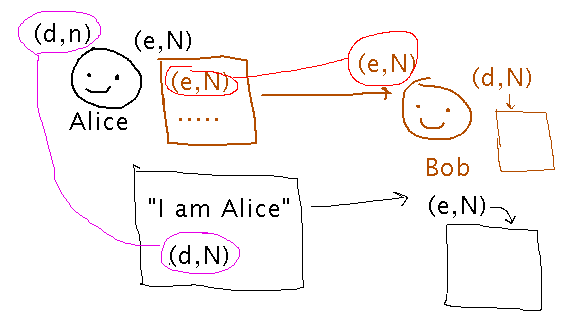
Try it with the public keys generated last time.
Next
Certificates.
Reflective essay.