Misc
Final
Monday, December 17, 8:00 AM.
In our regular classroom (Sturges 105).
Comprehensive, but emphasizing material since the midterm (e.g., summaries and quotations, rhetoric and logical fallacies, plagiarism, Alan Turing, book ciphers, modern cryptography, etc.)
Designed for 2 hours, you’ll have 3.
Rules and format otherwise similar to midterm, especially open-references and submission rules.
I’ll bring donuts and cider.
SOFIs
9 done so far. Thank you!
But please do more, the feedback is valuable for me.
Public Key Infrastructure and Digital Certificates
Recall this Google doc we used as a public shared “communication channel” for RSA.
How do you know the people in it are who they claim to be?
In the non-digital world, the answer would be via some sort of ID document, e.g., a driver’s license, that is hard to trick someone into issuing incorrectly and that might carry ways of checking that the document is presented by the right person (e.g., a photo or fingerprint).
The digital analog is a “digital certificate,” issued and signed by a “certificate authority” who presumably takes measures to make sure certificate recipients are who they say they are. Certificate authorities may “subcontract” to other CAs, so there’s a chain of authorities each certifying the identity of the next.
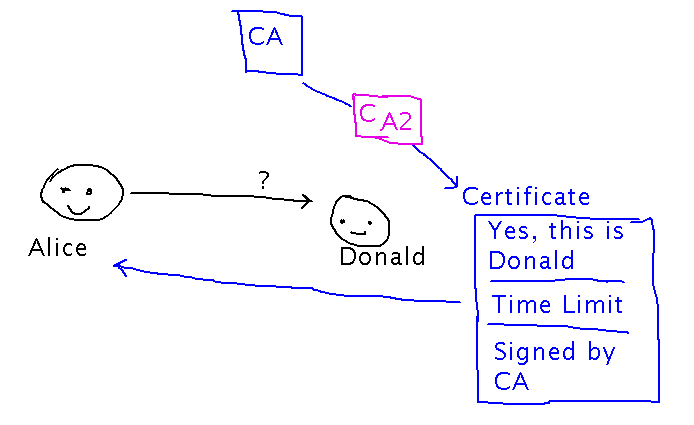
But note that all a certificate certifies is that a certain public/private key pair goes with a particular person or organization, not that the person or organization is engaged in “good” as opposed to “bad” activity with it.
Last Essay: Reflective Portfolio
See handout for details.